Sports Ground Drainage in India: Why It Fails and How to Build It Right
Walk around any sports complex that has been poorly maintained for a season or two and you will find the same problems: waterlogged corners, surface bubbling, patches of moss and fungal growth, and cracked edges where water has pooled and frozen or expanded.
Almost all of these problems have the same root cause: inadequate drainage.
India's monsoon climate makes drainage the single most important engineering consideration for any outdoor sports facility. Here is how to get it right.
Why Drainage Fails on Indian Sports Grounds
1. Flat or Improperly Graded Sub-Base
Water follows gravity. If the sub-base under a sports surface is not graded with a consistent slope toward drainage channels, water will pool in low spots. Even a 5mm depression in a concrete base can hold enough water to damage a surface over time.
The correct cross-fall for most sports surfaces is 0.5% to 1% — enough to move water without affecting playability.
2. No Perimeter Drainage Channels
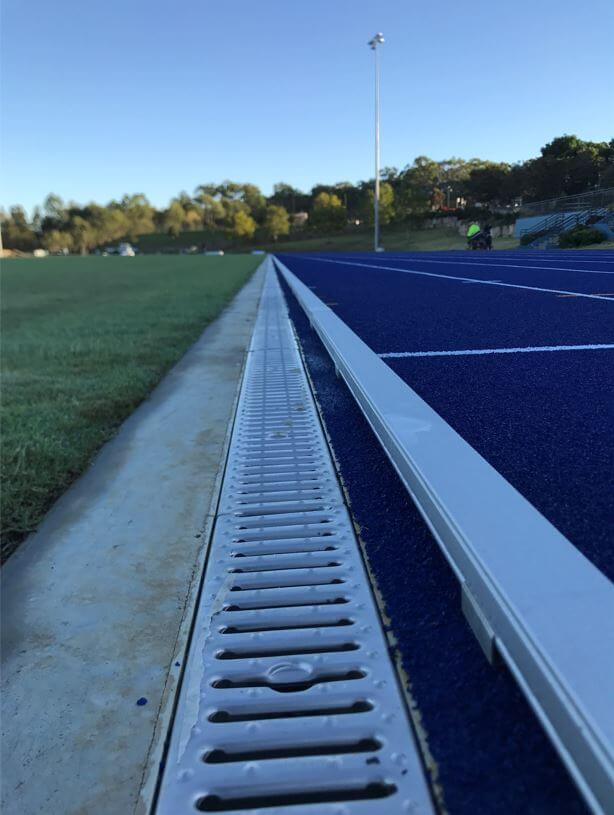
Even a perfectly graded surface will waterlog if there is nowhere for water to go at the edges. Perimeter channels with grated covers and connections to the site drainage network are essential on any surface larger than 100 sq m.
3. Inadequate Sub-Base Depth
A thin concrete or asphalt base on poorly compacted soil will flex under load and water pressure. This causes cracking, which allows water ingress, which accelerates deterioration in a cycle that ends with full resurfacing.
Minimum sub-base depth recommendations:
4. No Drainage Layer Under Synthetic Turf
Synthetic turf without a drainage layer underneath becomes a sponge. Water sits in the infill, creates anaerobic conditions, and generates the characteristic sulfur smell that plagues poorly built turfs within 2-3 seasons.
A properly built synthetic turf installation includes a permeable sub-base and drainage layer that allows water to pass through the turf and away from the surface.
How to Build Drainage That Works
Step 1: Site Survey and Level Assessment
Before any construction starts, the existing ground levels should be surveyed. This identifies natural drainage directions, low points, and any underground utilities that may affect drainage routing.
Step 2: Sub-Grade Preparation
The natural ground under the sub-base must be compacted and graded. Any organic material, loose fill, or soft patches must be excavated and replaced with compacted granular material.
Step 3: Sub-Base Construction
A compacted granular sub-base of the correct depth, graded to the required cross-fall, forms the foundation of the drainage system.
Step 4: Perimeter Drainage Installation
Perimeter drainage channels should be installed before the wearing surface. Channel size and spacing depends on the catchment area and expected rainfall intensity.
For Maharashtra and coastal India, drainage should be designed for a minimum of 100mm/hour rainfall intensity.
Step 5: Surface with Correct Falls
The wearing surface — whether acrylic, synthetic turf, or concrete — must maintain the drainage falls established in the sub-base. A flat surface laid on a graded sub-base will undo all the drainage engineering underneath it.
Drainage for Different Surface Types
Surface | Drainage Requirement |
Acrylic hard court | 0.5-1% cross-fall, perimeter channels |
Synthetic turf (football) | Permeable sub-base, 1% fall, drainage blanket |
Synthetic turf (padel/tennis) | Same as above with tighter tolerances |
Natural turf cricket | Subsurface drainage pipes at 5m spacing, outfield falls |
Wooden indoor court | No drainage required; focus on building envelope waterproofing |
The Cost of Getting It Wrong
Remedial drainage work on an existing court — lifting the surface, re-grading the base, reinstalling drainage, and relaying the surface — typically costs 60-80% of the original construction cost.
Building drainage correctly the first time is always cheaper.
CapsInfra's Drainage Approach
Every CapsInfra project starts with a site survey that includes level assessment and drainage planning. We include perimeter channels, sub-base grading, and drainage falls as standard — not as optional extras.
[Book a free site assessment →](/contact)